
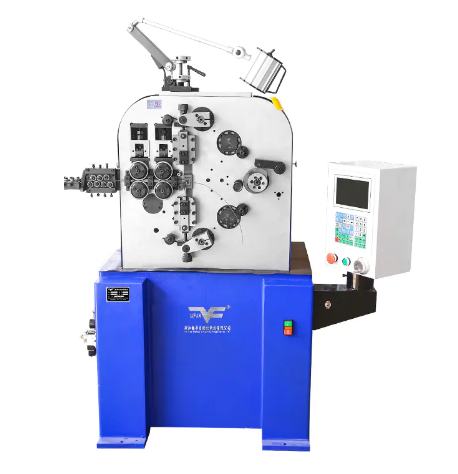
The CNC spring coiler has brought significant changes to how springs are formed in modern manufacturing environments. With its programmable control system, this equipment automates the process of winding wire into coils, improving consistency and reducing manual labor. As the demand for custom and intricate spring shapes grows, machines like these offer solutions that traditional forming methods may find challenging to achieve.
A CNC spring coiler operates through a combination of servo motors, feeding systems, and forming tools. Operators can input detailed parameters such as wire diameter, coil pitch, and number of turns, allowing for a high degree of customization. The software interface simplifies programming adjustments and ensures that repeatable production can be carried out with minimal deviation between pieces.
These machines are used in a range of industries, including automotive, electronics, and medical devices. Their flexibility enables the production of compression, tension, and torsion springs from various materials. High-speed capabilities also support mass production without compromising the quality of each coil.
Another notable advantage is the ease of integrating quality control checks within the same operation. Sensors and measuring systems can monitor critical dimensions in real-time, allowing prompt corrections if deviations occur. This integrated approach helps to reduce waste and enhances production efficiency.
As technology advances, CNC spring coilers continue to evolve, offering better software interfaces, improved mechanical components, and enhanced compatibility with digital monitoring tools. For manufacturers looking to balance precision and output, the CNC spring coiler is an essential piece of equipment that continues to play a central role in spring fabrication.

 English
 Arabic
 French
 Spanish
 Portuguese
 Turkish
 Dutch
Dutch
 Italiano
 Russian
 Romaian
 Portuguese (Brazil)
 Greek
Greek