
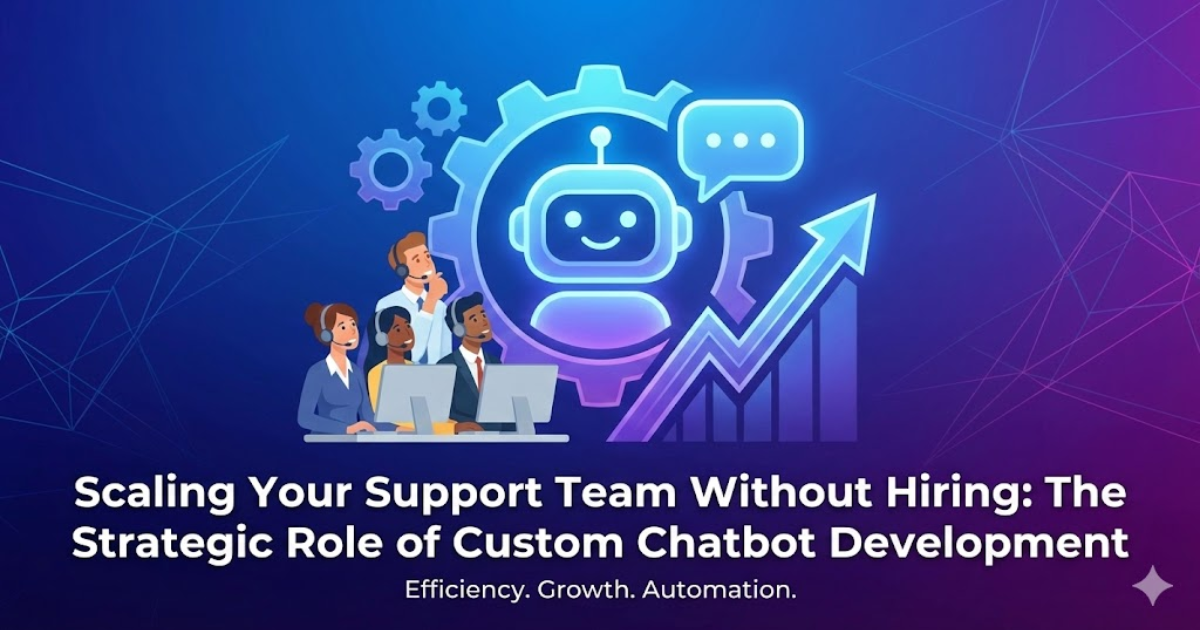
Customer support leaders face a brutal paradox. Ticket volumes grow exponentially as you scale, but your headcount budget grows linearly at best. The traditional "hire more agents" model breaks under pressure. It creates training bottlenecks, management overhead, and inconsistent service quality during traffic spikes.
Smart organizations solve this not by hiring, but by engineering. They treat support as a technical product, not just a human service. This shifts the focus from "managing people" to "managing architecture."
The Mathematics of Scale: Why Hiring Fails
Human support scales linearly. To handle 2x volume, you roughly need 2x the agents. This equation ignores the hidden costs of management layers, turnover, and onboarding.
Consider the unit economics of a support ticket. Industry data from 2025 places the fully loaded cost of a human-resolved ticket between $6 and $12 for mid-sized tech companies. For complex technical queries, this often exceeds $45.
Contrast this with automation. A custom chatbot system resolves tickets for cents.
The Efficiency Gap
- Resolution Time: Humans take minutes. Bots take milliseconds.
- Concurrency: A human handles 1-3 chats. A bot architecture scales to thousands of concurrent threads instantly.
- Availability: Humans need shifts. Bots offer "always-on" global coverage without overtime pay.
Statistics reinforce this shift. Recent market reports indicate that AI resolves 54% to 96% of simple queries without human intervention. By removing Tier-1 noise, you reserve your expensive human talent for high-value, complex problem-solving.
Technical Architecture of a Scalable Bot
Off-the-shelf "no-code" builders rarely survive enterprise scale. They lack the latency control, security compliance, and integration depth required for serious volume. A professional Chatbot Development Company builds a system, not just a script.
1. Decoupled Microservices
Scalable bots do not live on a single server. Developers design them as a collection of microservices.
- The Gateway: Handles incoming WebSockets or REST API calls from your frontend.
- The Brain (NLU/LLM): Processes intent and context.
- The Action Layer: Executes logic (e.g., "Reset Password", "Query Order Status").
- The Storage: Vector databases (like Pinecone or Milvus) for memory and context.
This decoupling ensures stability. If the NLP engine slows down under load, the message queue buffers requests. The user experiences no downtime.
2. Retrieval-Augmented Generation (RAG)
Modern bots do not guess; they retrieve. Developers implement RAG architectures to ground the AI in your specific company data.
- Ingestion: The system scrapes your Help Center, API docs, and internal Wikis.
- Vectorization: It converts text into mathematical vectors.
- Retrieval: Upon receiving a query, the bot searches for the most relevant vectors.
- Generation: The LLM synthesizes an answer using only that retrieved context.
This architecture eliminates hallucinations. It ensures the bot cites its sources. It allows you to update the bot's knowledge instantly by updating a wiki page, without retraining the model.
Deep Integration: Beyond Simple Q&A
A chatbot that only answers FAQs adds limited value. True scaling happens when the bot performs actions. This requires deep backend integration.
1. The API Ecosystem
Your Chatbot Development partner will build middleware to connect the bot to your tech stack.
- CRM (Salesforce/HubSpot): The bot identifies the user by email. It pulls their subscription tier and sentiment score before sending the first reply.
- ERP (SAP/NetSuite): The bot checks real-time inventory levels. It processes returns and generates shipping labels dynamically.
- Authentication (OAuth/SSO): The bot validates user identity securely. It handles sensitive PII (Personally Identifiable Information) within compliant, encrypted tunnels.
For example, a fintech bot doesn't just say "Check your settings." It authenticates the user via biometric prompt, queries the transaction database via SQL, identifies the failed charge, and offers a one-tap dispute button. This is engineering, not conversation design.
Strategic Implementation: The Development Lifecycle
Building a custom solution requires a disciplined roadmap. A robust development cycle mitigates risk and ensures ROI.
Phase 1: Data Audit and Cleaning
Garbage in, garbage out. You must audit your historical chat logs. Engineers use clustering algorithms to group past tickets into "Intents." This reveals what your customers actually ask, rather than what you think they ask.
Phase 2: The Logic Design
Developers map out "happy paths" and edge cases. They define the state machine.
- State: User is unverified.
- Input: "Where is my order?"
- Action: Trigger Auth_Flow.
- New State: User is verified.
- Action: Trigger Order_Lookup_API.
Phase 3: Stress Testing
Before launch, the system undergoes load testing. Engineers simulate 10x traffic spikes. They measure latency at the 99th percentile (p99). They ensure the webhook timeouts handle slow third-party APIs gracefully.
Measuring Success: KPIs That Matter
Do not measure "number of conversations." That is a vanity metric. Focus on operational impact.
- Deflection Rate: The percentage of sessions that never reach a human agent. A healthy target is 30-50% in the first quarter.
- API Success Rate: How often does the bot successfully execute a backend action (e.g., processing a refund)?
- latency: The time between user input and bot response. Keep this under 800ms to maintain the illusion of immediate thought.
- Sentiment Drift: Does customer sentiment improve or degrade during the bot interaction?
The Build vs. Buy Decision
SaaS platforms offer speed. Custom development offers control.
Choose a Chatbot Development Company when:
- Data Security is Paramount: You need on-premise deployment or strict GDPR/SOC2 compliance.
- Workflows are Complex: Your support involves multi-step proprietary logic (e.g., diagnosing a hardware device via telemetry).
- Brand Identity Matters: You need a specific tone of voice or UI that standard widgets cannot support.
- Long-Term Cost: SaaS subscriptions scale with volume. Custom code has a higher upfront cost but near-zero marginal cost per interaction.
Conclusion
Scaling support is no longer a hiring problem. It is a routing and automation problem. By deploying a custom chatbot, you build an asset that appreciates over time. The bot learns. It gets faster. It handles the holiday rush without complaining.
This strategy protects your human team. It insulates them from the repetitive grind. It frees them to handle the empathetic, high-stakes issues that actually require a human touch.
Invest in code. Build the infrastructure. Watch your capacity scale while your headcount remains stable.

 English
 Arabic
 Spanish
 Portuguese
 Deutsch
 Turkish
 Dutch
Dutch
 Italiano
 Russian
 Romaian
 Portuguese (Brazil)
 Greek
Greek